


NEWS
How Students Bypass School Content Filters — and How to Stop Them
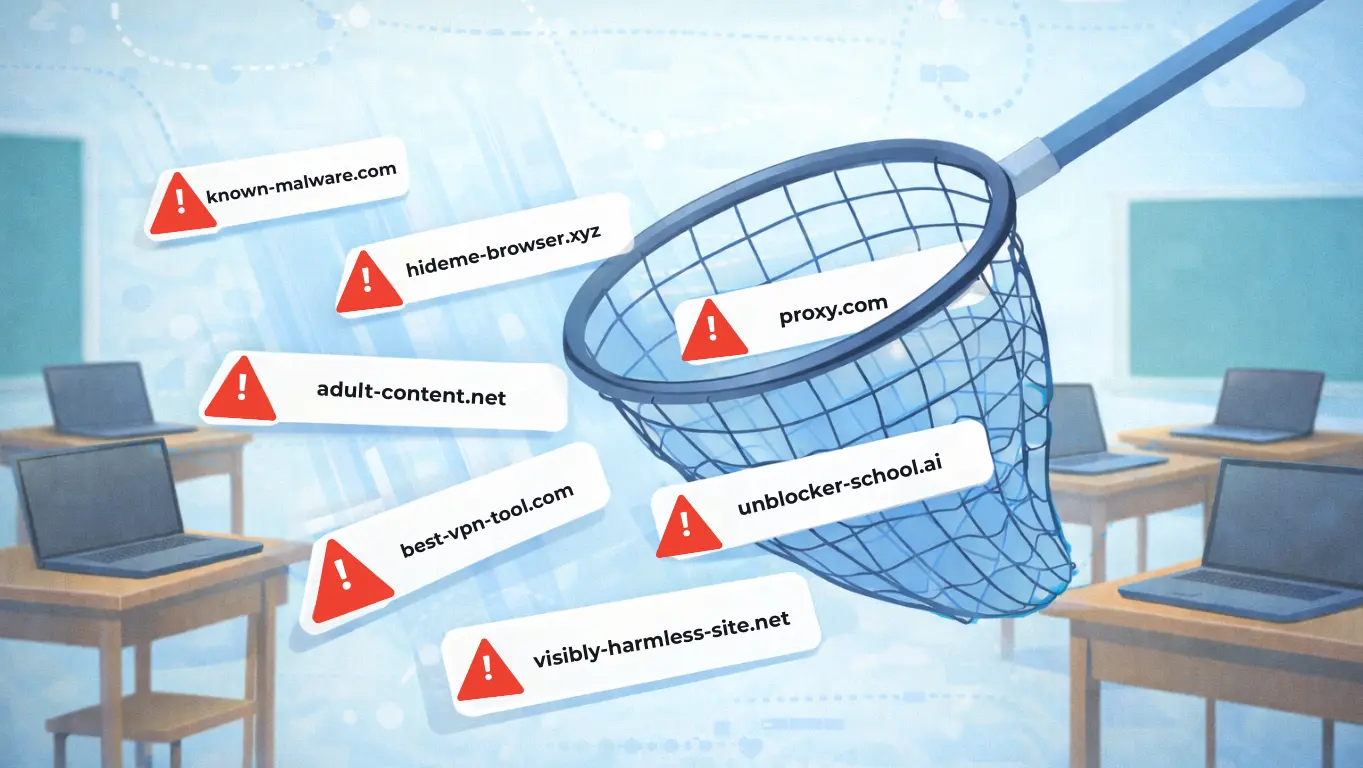
If you manage content filtering for a K-12 district, you’ve probably seen this play out: you block a site, students find a workaround, you block that too. The cycle continues. It’s not a new problem, but it’s getting harder to manage.
The reason? Most content filters are built around what they already know. The moment a student steps outside that known territory, a new URL or a freshly created proxy site, the filter has a gap. And students are finding those gaps faster than ever.
This post breaks down how students are bypassing school filters in 2026, why traditional filtering struggles to keep up, and how Blocksi addresses both weak points.
Why Do Students Bypass School Content Filters?
Students bypass filters for all kinds of reasons — accessing social media, gaming sites, or content that’s restricted by school policy. What’s changed is how easily they share bypass methods. Tips get posted on Reddit, tutorials go up on TikTok, and proxy links get passed around in Google Docs. By the time your IT team flags a workaround, there’s usually another one already circulating.
The methods themselves aren’t always complex:
- Web-based proxy sites — a student enters a blocked URL into a proxy site, which fetches the content on their behalf. No installation needed.
- VPN browser extensions — installed from the Chrome Web Store, these route traffic through external servers to mask the destination.
- Newly registered or obscure URLs — sites that haven’t been categorized by any blocklist yet, making them invisible to traditional filters.
- Rebranded proxy tools — extensions that look like harmless apps but function as bypass tools.
The scale of this is significant. According to DNSFilter‘s November 2025 research, traffic to proxy and filter-avoidance categories in education spiked 83% on a single day compared to the previous 12-month average — and the education industry ranked third highest for proxy/filter-avoidance requests overall.
Where Traditional Filters Fall Short
Most content filters work by checking a URL against a database of categorized sites. If it’s on the list, the policy applies. If it’s not — the site often loads by default.
That’s the core problem. Security researchers observe millions of new domains every single day. A proxy site can be created, used, and abandoned within days. A blocklist updated weekly simply can’t keep up.
There are two specific gaps this creates:
- Harmful content on allowed domains — a page on a permitted site can contain content that violates policy, but a traditional filter only sees the domain, not what’s actually on the page.
- Proxy and VPN bypass tools — new proxy sites are created constantly, specifically to stay ahead of blocklists. By the time a proxy is categorized and blocked, students have already moved to the next one.
How Blocksi’s AI Context Filter Works as a Second Layer
What is AI Context Filtering, and how does it work?
Blocksi‘s AI Context Filtering doesn’t stop at what the traditional web filter decides. It analyzes the actual content of every page the traditional filter allows through — catching harmful content even on domains that are fully permitted.
Here’s what happens when a student visits any site that passes through the web filter:
- Blocksi’s traditional web filter checks the URL first — category rules, blocklists, exception lists.
- If the page is allowed through, the AI Context Filter activates as a second layer.
- Page content is extracted and sent to Blocksi’s LLM-powered classification service, which assigns the most appropriate category.
- If the assigned category matches a blocked policy, the page is blocked — even if the URL was initially allowed.
This means that instead of defaulting to ‘allow’ for every page that passes through, Blocksi evaluates it first. The system processes approximately 500,000 classification requests per day, and for previously visited URLs, filtering is instant, with results returned in milliseconds.
Why does this matter in practice?
Consider a student who visits a social media platform — a domain your filter allows. A specific page on that platform contains content about alcohol. A traditional filter sees an allowed domain and lets it through. Blocksi’s AI Context Filter evaluates the actual page content and blocks it based on what’s there, regardless of what domain it lives on. This is the core strength of fine-grained, page-level filtering: it doesn’t matter if the domain is allowed — what matters is what’s actually on the page.
This is especially relevant for dynamically generated content — pages on forums, social platforms, or content aggregators where harmful content can appear on otherwise benign domains.
Blocksi admins consistently report that the biggest benefit of AI Context Filtering is coverage without over-blocking — the ability to set broad category rules with confidence that edge cases and newly created sites are handled automatically, without constantly adding manual exceptions.
How Blocksi Blocks Proxy Bypass Attempts
What is Smart Proxy Detection?
Smart Proxy Detection is a feature built into Blocksi’s web filter that blocks sites exhibiting proxy or VPN behavior, even before they’ve been officially categorized.
When a new proxy site is created, there’s typically a window of up to two days before it gets rated and categorized by filtering databases. During that window, traditional filters have no way to know it’s a proxy. Students can — and do — use that gap.
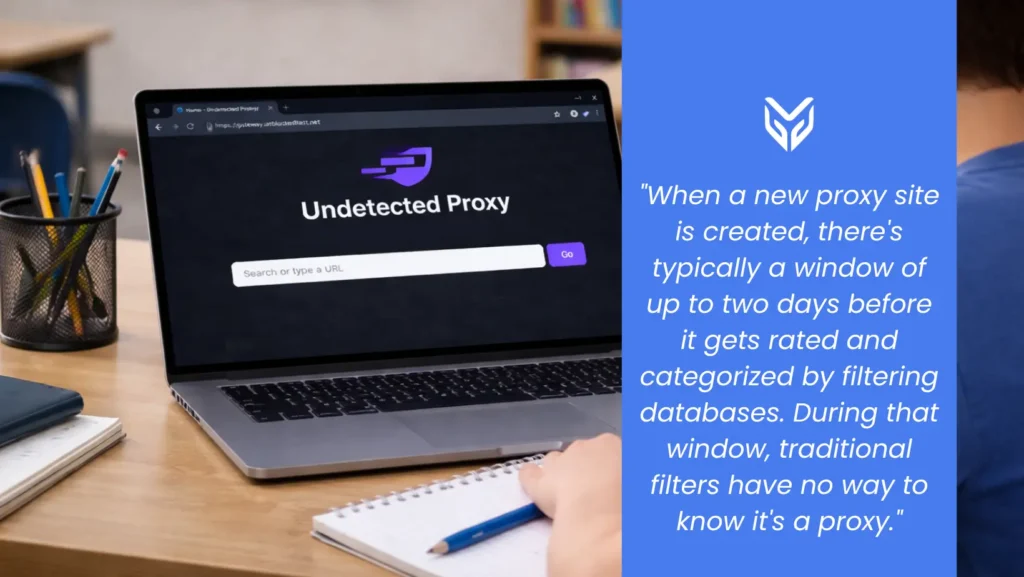
Smart Proxy Detection closes it by analyzing site behavior rather than waiting for a category assignment. When enabled, it detects web-based VPNs, tunneling pages, and traffic-hiding or redirection behavior, and flags those sites as Proxy Avoidance, applying your existing admin-defined blocking policy immediately.
What does the Smart Proxy Detection catch?
- Web-based VPN sites
- Tunneling pages
- Traffic-hiding and redirection tools
- Newly created proxy sites not yet rated by category databases
It’s controlled through a simple toggle in the Admin Dashboard under Content Filtering → Web Filter, and it works alongside your existing category-based filtering rules without replacing them.
How AI Context Filtering and Smart Proxy Detection Work Together
AI Context Filtering and Smart Proxy Detection address different but complementary problems.
AI Context Filter evaluates every page the traditional filter allows through — catching harmful content whether the URL is unknown, newly created, or on a fully permitted domain. Smart Proxy Detection specifically targets bypass behavior — sites built to redirect students around your filter, regardless of what content they’re ultimately trying to access.
Together, they cover the two main ways traditional filtering gets beaten:
| Filtering gap | How students work around it | How Blocksi addresses it |
| Harmful content on allowed domains | Access harmful pages on permitted sites — social media, forums, content aggregators | AI Context Filter evaluates page content in real time and blocks it regardless of domain |
| Proxy bypass | Use proxy sites to route around filtering entirely | Smart Proxy Detection blocks proxy behavior before categorization |
Neither feature requires manual updates or constant admin intervention. They work in the background, within your existing filtering setup.
Key Takeaways
Students bypassing school content filters is a persistent problem, and it’s getting more sophisticated. Traditional filters built around static blocklists will always have a lag between when new content or proxy tools appear and when they’re categorized and blocked.
Blocksi’s AI Context Filtering and Smart Proxy Detection address this directly:
- AI Context Filtering evaluates any page the traditional filter allows through in real time, classifying content based on what’s actually on the page — not whether it’s been pre-catalogued.
- Smart Proxy Detection identifies proxy and VPN behavior immediately, closing the categorization gap that new bypass tools exploit.
If your current filter is reactive — blocking things only after they’ve been identified and categorized — it’s worth looking at what’s getting through in the meantime. See how Blocksi handles these gaps in your environment.
FAQ
How do students bypass school content filters? The most common methods are web-based proxy sites, VPN browser extensions, and navigating to newly created URLs that haven’t been categorized by the filter yet. Students also share bypass methods quickly through social media and online forums.
Can a content filter block proxy sites it hasn’t seen before? Traditional filters can’t — they rely on known categories and blocklists. Blocksi’s Smart Proxy Detection identifies proxy behavior directly, blocking sites that act like proxies even before they’ve been officially categorized.
What is AI Context Filtering in school content filters? Blocksi’s AI Context Filter analyzes the content of every page the traditional web filter allows through — not just uncategorized ones. Even a page on a permitted domain gets evaluated in real time, so harmful content on an allowed site doesn’t slip through.
Does AI Content Filtering work on Chromebooks? Yes. Blocksi’s AI Context Filtering runs through the Blocksi Chrome Extension, which is compatible with Chromebooks managed through Google Workspace for Education.
How long does it take for a new proxy site to get blocked? With traditional category-based filtering, it can take up to two days for a newly created proxy site to be rated and categorized. Blocksi’s Smart Proxy Detection closes this window by detecting proxy behavior immediately, regardless of whether the site has been categorized yet.
Does Blocksi work for BYOD devices? Yes. For managed devices, Blocksi uses the Chrome Extension for AI-powered filtering. For BYOD and unmanaged devices, Blocksi’s DNS filtering and on-premise appliance provide network-level coverage.
SOURCES
[1] DNSFilter Data Reveals Major Threat Vector as Students Bypass School Security Controls
[2] Flagging 13 Million Malicious Domains in 1 Month with Newly Observed Domains
More to Explore

Follow Our Social Media Channels


