


NEWS
What K-12 IT Is Seeing in 2026: The Latest Student Bypass Methods
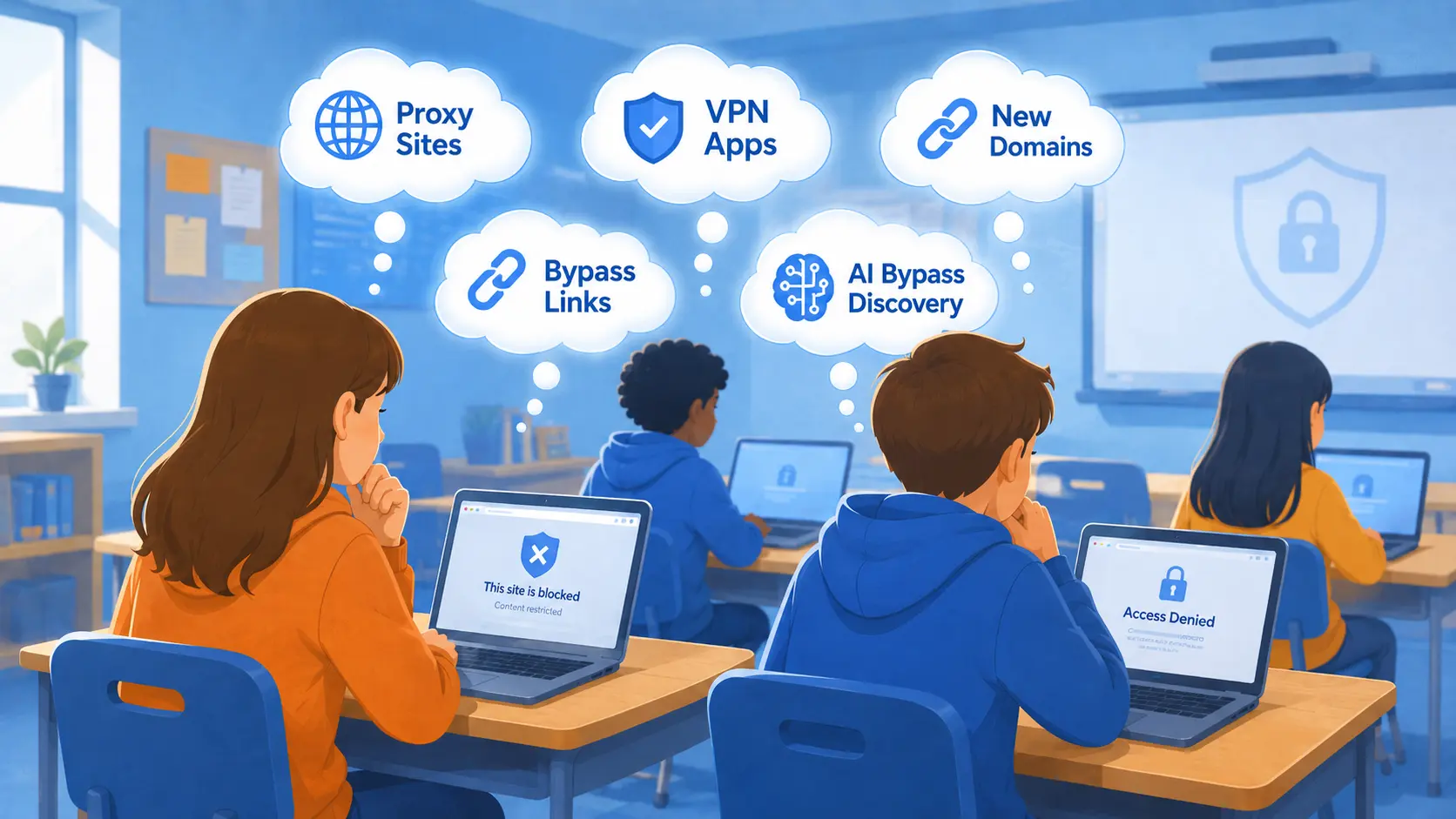
Student bypass isn’t a new problem — but 2026 has made one thing clear: students are moving faster than most filters can follow. The filtering bypass methods are more accessible, the tools are easier to deploy, and the links spread across Discord servers and Reddit threads before your IT team has finished their morning coffee.
What’s changed isn’t just the technology. It’s the scale and speed. A single working filtering bypass method shared in a group chat can reach an entire grade level in minutes. By the time it gets flagged, there’s already a replacement circulating.
This post focuses on what’s actually showing up on school networks right now: the specific student filtering bypass methods schools are dealing with in 2026, why your filter may not be catching them, and what a detection approach built for this environment actually looks like.
What School Filter Bypass Methods Are Students Using Right Now?
The landscape in 2026 isn’t radically different from three years ago — but it’s significantly more sophisticated. Here’s what’s active on K-12 networks:
- Web-based proxy sites. A student enters a blocked URL into a proxy site, which fetches the content on their behalf — no installation needed.
- VPN browser extensions. Installed from the Chrome Web Store in under a minute, these route traffic through external servers. VPNs with obfuscation features disguise their traffic as regular web browsing, making them nearly impossible for a firewall to detect.
- Proxy scripts hosted on trusted platforms. Students can clone and deploy open-source proxy scripts that go undetected or appear academic.
- Newly registered domains. 547,000 new websites are created every day and the vast majority are never reviewed before students can reach them. A proxy site can be created, shared, and burned within 48 hours, well before any categorization database catches up.
- Discord-shared bypass links. Students share working bypass methods through Discord servers, Reddit threads, and Google Docs almost instantly. Proxy misuse has become a frontline threat in school environments, in part because circumvention tools spread peer-to-peer faster than traditional filters can respond.
- DNS manipulation. When schools block sites using DNS filters, switching to a public DNS service like Google or Cloudflare may bypass the filter entirely. No software, no extensions — just a settings change.
- Trusted platforms as backdoors. Apps like Discord or Reddit can surface blocked content through built-in browsers and embedded links — platforms that are often too embedded in school workflows to block outright.
- AI-assisted bypass discovery. Students are using AI-generated circumvention strategies to find gaps in filtering policies that weren’t anticipated when those policies were written.
Why Can’t Traditional Filters Keep Up?
The problem isn’t effort — most IT teams are running their filters correctly. The problem is architecture.
- The categorization lag. Most content filters check a URL against a database of categorized sites. If it’s on the list, the policy applies. If it’s not, the site often loads by default. When a new proxy site is created, there’s typically a window of up to two days before it gets rated and categorized by filtering databases — and students can, and do, use that gap.
- The domain-vs-content gap. Category databases categorize domains, not pages. A student can access objectionable content on a fully whitelisted domain. The domain is trusted. The content isn’t. Traditional filters have no mechanism to distinguish between the two.
- Obfuscated traffic. VPN obfuscation, client-side proxy logic via service workers, and encrypted tunneling all present traffic that looks legitimate at the network level. Filters built purely around URL categorization have no reliable way to flag it.
These aren’t edge cases. They’re structural weaknesses baked into any filter that relies on categorization alone.
What Actually Closes These Gaps?
Two capabilities make the difference: behavioral detection and content-level analysis. Blocksi builds both into its filtering layer and they sit within a broader multi-layer filtering architecture designed to cover the gaps no single feature can close alone.
- Smart Proxy Detection addresses the categorization lag directly. Rather than waiting for a new proxy or VPN site to be identified and added to a database, it analyzes site behavior and applies the existing blocking policy immediately, even if the domain has never been seen before.
- AI Context Filter addresses the domain-vs-content gap. It activates as a second layer on every page the traditional filter allows through — not just uncategorized or unknown domains. It analyzes the actual content of the page, and if the content is inappropriate, it gets blocked regardless of what domain it lives on.
Together, these two features cover the two failure modes that students exploit most consistently in 2026. For a detailed breakdown of how each works, see our post: How Students Bypass School Content Filters.
Key Takeaways
The 2026 school content filter bypass environment is shaped by speed and distributed sharing. Students don’t need to be sophisticated — they just need a working link from someone in their Discord server. The tools they’re using are all specifically designed to exploit the same thing: the delay between a bypass method appearing and a filter catching up to it.
How students bypass web filters has changed less in kind than in scale and speed. What’s changed is how fast bypass methods propagate and how accessible self-hosted proxy infrastructure has become.
Blocksi’s behavioral proxy detection and AI-driven content analysis approach is built specifically for this environment. Rather than waiting for a domain to be categorized, it acts on behavioral signals the moment they appear. On every page the traditional filter passes through, the AI Context Filter evaluates actual content — blocking what the URL alone wouldn’t reveal.
See how Blocksi detects filter bypass behavior before it becomes a pattern.
FAQ
What are the most common school filter bypass methods in 2026?
The most active methods right now are web-based proxy sites, VPN browser extensions with obfuscation, proxy scripts, newly registered domains that haven’t been categorized yet, and bypass links shared through Discord. Simply changing DNS settings to a public resolver also continues to work against filters that operate only at the DNS level.
How fast do new bypass methods spread among students?
Faster than most IT teams can respond. Bypass links and tutorials circulate through Discord servers, Reddit threads, and shared Google Docs within minutes of being posted. By the time a workaround gets flagged, there’s usually already a replacement in circulation.
Why can’t traditional content filters block new proxy sites immediately?
Traditional filters depend on categorization databases that take time to identify and classify new domains. A proxy site can be created, distributed, and used within hours — well before any database flags it. Behavioral detection, like Blocksi’s Smart Proxy Detection, closes this gap by analyzing what a site does rather than waiting for it to be categorized.
What does proxy detection K-12 filtering actually look like in practice?
Effective proxy detection for K-12 doesn’t rely on blocklists. It analyzes behavioral signals: traffic redirection patterns, tunneling indicators, and filter-evasion behaviors. When Blocksi’s Smart Proxy Detection identifies these signals, it categorizes the site as Proxy Avoidance and applies your admin-defined policy immediately, without requiring a prior category assignment.
SOURCES
[1] How Many Websites Are There in the World?
[2] DNSFilter Data Reveals Major Threat Vector as Students Bypass School Security Controls
[3] Guide to List of Websites Blocked by Schools in 2026
More to Explore
Follow Our Social Media Channels


